
Education Theory - Conclusion
Part 6: What is education for?

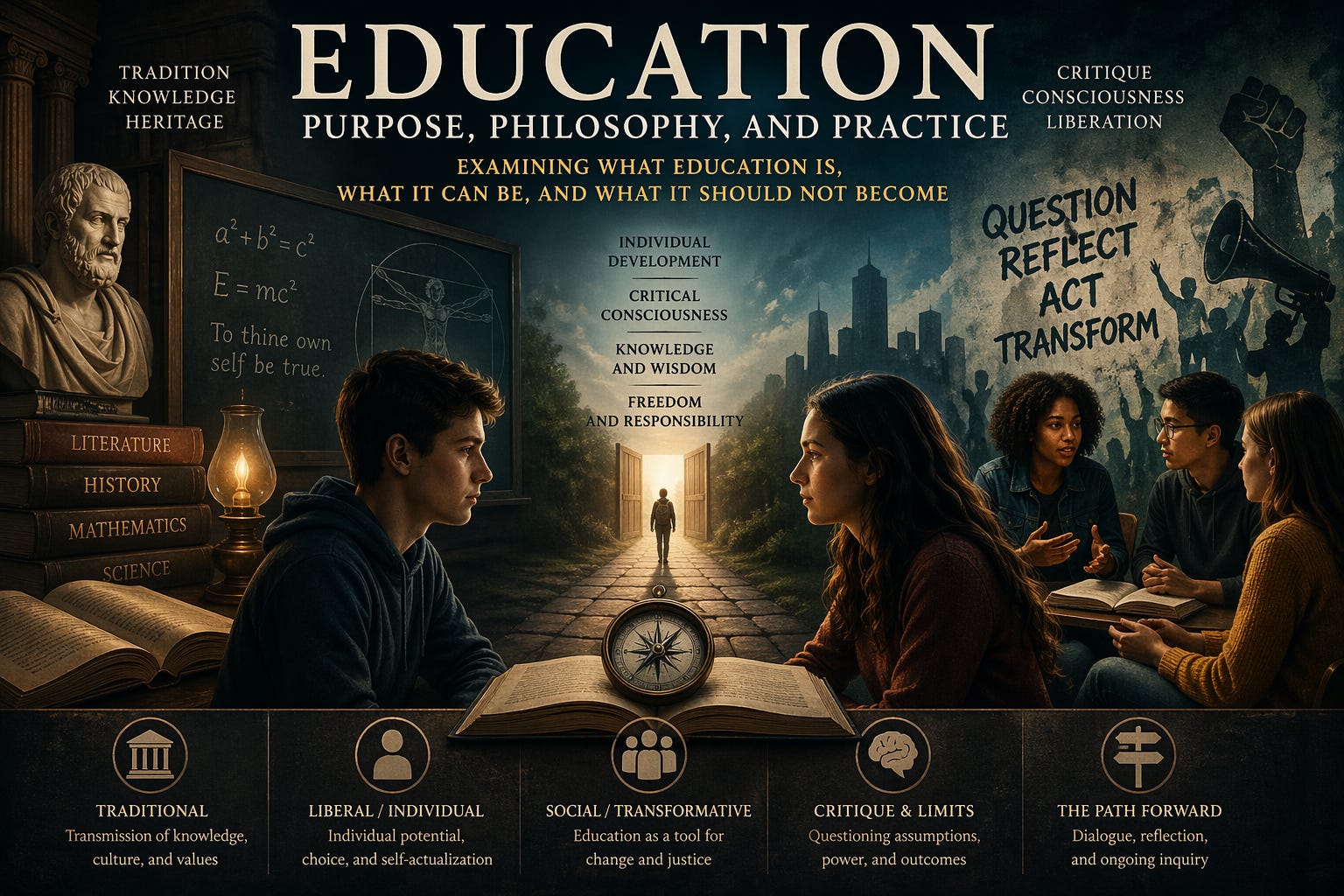
So what is education for?
At the outset, it’s easy to fall back on a general answer. Most people agree that education is indispensable. It is taken as a given in any functioning society.
But that only pushes the real question one step further:
indispensable for what purpose?
Part of the difficulty is that there has never been a single answer.
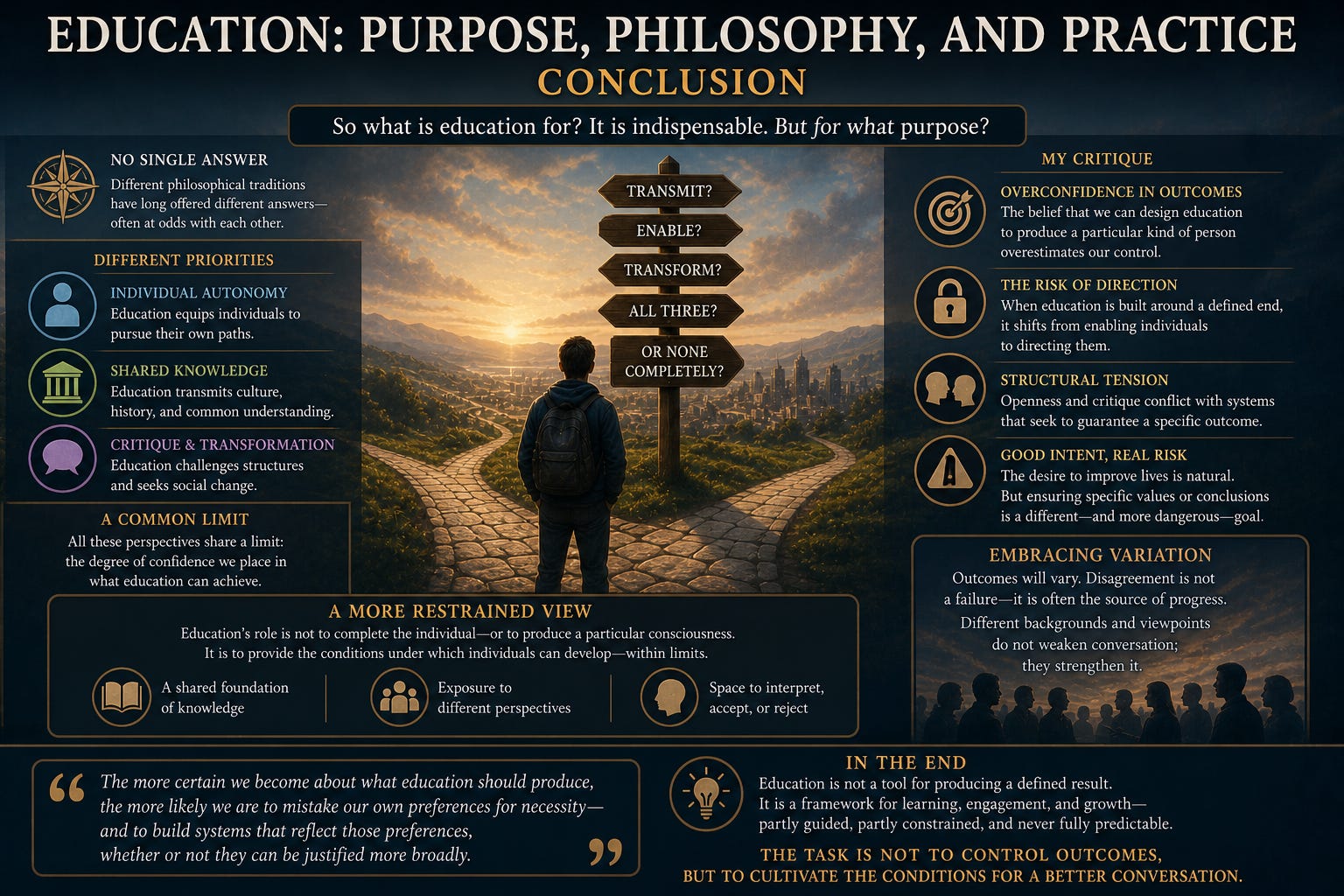
Different philosophical traditions have approached education with different assumptions—often at odds with one another. Some emphasize individual autonomy. Others stress shared knowledge and cultural continuity. Still others see education as a means of critique and transformation.
Taken together, these perspectives point toward a common limit.
Up to this point, the critiques we’ve looked at come from different directions, but they converge on one issue:
how much we believe education is capable of doing.
My own concern builds on that.
It is not that education has no power. Clearly it does.
Nor is it that critique is unnecessary. It isn’t.
The issue is the degree of confidence placed in what education can achieve.
There is a growing tendency to treat education as if it can move beyond shaping behavior or transmitting knowledge—and instead complete the individual. That with the right structure, the right curriculum, and the right method, it is possible to produce a particular kind of person.
That assumption deserves more scrutiny than it often receives.
It requires us to accept two claims at once:
that individuals are largely formed by their environment
and that the environment can be intentionally designed to produce a desired outcome
Both of these are stronger claims than they first appear.
They imply a level of control over human development that is difficult to sustain in practice.
People are not infinitely malleable. They are not simply the sum of their surroundings. They come into the world with differences in disposition, temperament, and inclination that are not easily overridden.
Education interacts with those traits—it does not replace them.
A simple example makes the point.
My parents were both social democrats. Their eldest son—me—was describing himself as a Tory by the age of ten.
There’s a tendency to assume that the right environment produces the intended result. But the relationship is not that direct.
At the same time, that environment did produce something valuable.
We learned how to disagree—cordially. How to argue without collapsing into hostility. That may be a more realistic and more useful outcome than trying to ensure agreement in the first place.
From this standpoint, the role of education becomes more limited—but also more grounded.
It can:
provide a shared body of knowledge
introduce ways of thinking
create opportunities for reflection
But it cannot fully determine what a person becomes.
And when education is structured as if it can, it begins to take on a different character.
It shifts from enabling individuals to directing them.
This is where the concern about outcome-driven models becomes more concrete.
If education is designed with a specific end in mind—whether framed as liberation, critical awareness, or social transformation—then that end begins to shape everything else:
what is taught
how it is taught
what is emphasized
and what is left aside
Even when the stated goal is broad, it still carries assumptions about what counts as progress.
At that point, education is no longer simply opening possibilities.
It is organizing them toward a preferred conclusion.
That doesn’t require bad intent. It follows from the structure itself.
This is why I am skeptical of approaches that treat education as a primary tool for reshaping society.
Not because education is irrelevant to social outcomes—but because it is not precise enough, nor neutral enough, to bear that weight without consequence.
There is also a deeper tension.
A method built on critique assumes openness—it depends on the ability to question, revise, and remain unsettled.
But a system designed to produce a particular outcome introduces closure—it defines in advance what the process is meant to achieve.
Trying to hold both at once creates a contradiction.
The more clearly the goal is defined, the less open the process becomes.
And the more open the process remains, the less control there is over the outcome.
That is not a problem that can be solved through better design.
It is a structural limit.
It’s also worth recognizing why approaches like those of Paulo Freire became so influential.
They appeal to something very natural in educators—the desire to improve lives, especially for those who are disadvantaged.
That impulse is not misguided.
But it can become too expansive.
There is a difference between helping someone improve their life, and attempting to ensure they emerge with a specific set of values or conclusions.
Which leads to a more restrained view of education.
Its role is not to complete the individual.
Nor is it to produce a particular type of consciousness.
It is to provide the conditions under which individuals can develop—within limits that neither the individual nor the system fully controls.
That includes:
a shared foundation of knowledge
exposure to different perspectives
and the space to interpret, accept, or reject what is encountered
It also means accepting something less comfortable:
Outcomes will vary—sometimes significantly—and not always in ways that align with the intentions of those designing the system.
But that variation is not purely a weakness.
Education has always produced disagreement—and through that, movement.
Better ideas often emerge not from uniformity, but from tension between different viewpoints.
In that sense, the diversity of perspectives that individuals bring—their backgrounds, experiences, and inclinations—is not something to be eliminated, but something that contributes to the process itself.
Which brings us back to the original question.
What is education for?
Not to produce a single outcome.
Not to resolve disagreement.
And not to complete the individual.
It is to create a framework in which people can learn, engage, and develop—partly guided, partly constrained, and never fully predictable.
And if there is a caution worth keeping in mind, it is this:
The more certain we become about what education should produce, the more likely we are to mistake our own preferences for necessity—and to build systems that reflect those preferences, whether or not they can be justified more broadly.