
Looking Backward
Part 3: The Past We Can't Leave Behind

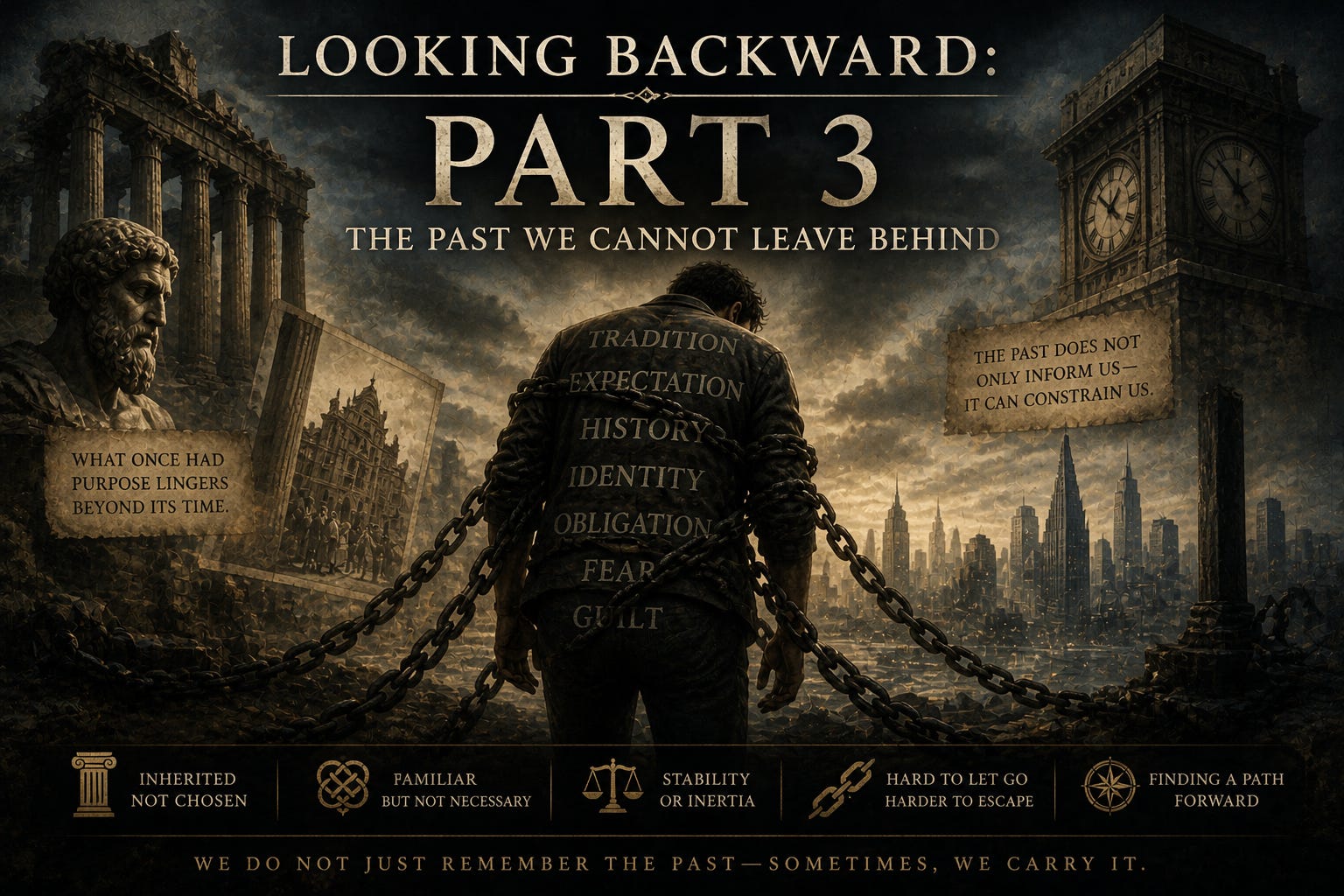
If myth represents the past as something elevated—refined into an ideal—there is another way of encountering it that is far less comfortable.
Not as something we shape, but as something that shapes us.
There is a tendency to think of history as distant. Something that can be studied, interpreted, even revised. But in practice, much of what we call the past is not behind us in any meaningful sense. It continues forward, embedded in institutions, habits, and ways of thinking that outlast the circumstances that created them.
In this sense, the past is not remembered—it is carried.
This is most visible in tradition. Customs, norms, and inherited structures often persist long after their original purpose has faded. What once served a clear function becomes something closer to reflex. It is maintained not because it is understood, but because it is familiar.
The difficulty is that familiarity can be mistaken for necessity.
At times, this persistence provides stability. It offers continuity in a world that would otherwise feel unmoored. But it can also produce a kind of inertia. The past, rather than guiding action, begins to limit it. Possibilities narrow, not because they are impossible, but because they fall outside what has already been established.
This creates a different problem than the one posed by myth.
In myth, the past is too perfect. It risks becoming unattainable.
Here, the past is too present. It risks becoming unavoidable.
We see this not only in institutions, but in identity itself. Individuals and societies alike inherit narratives about who they are—stories that define what is expected, what is permissible, and what is worth pursuing. These narratives are rarely questioned in their entirety. More often, they are adapted at the margins while their core remains intact.
The result is a subtle constraint.
We believe we are choosing freely, but the range of choices has already been shaped.
This is not always obvious. Unlike myth, which openly presents itself as a story, inherited structures tend to appear natural. They do not announce themselves as products of the past. They present themselves as simply “the way things are.”
And that is precisely what makes them difficult to confront.
To move beyond them requires more than disagreement. It requires recognition—that what feels fixed may, in fact, be contingent. That what has been carried forward was not inevitable, but constructed under different conditions.
Yet even when this is understood, letting go is not straightforward.
The past is rarely discarded all at once. It lingers in fragments—in language, in expectations, in the quiet assumptions that shape how we interpret the world. Change, when it comes, is uneven. Some elements are abandoned, others persist, and still others return in altered form.
This leaves us in an uncertain position.
If we hold too tightly to what came before, we risk becoming bound by it—unable to adapt when circumstances shift. But if we attempt to sever ourselves from it entirely, we risk losing the continuity that gives actions meaning in the first place.
Between these two, there is no simple resolution.
The past cannot be fully preserved. Nor can it be entirely escaped.
And it is here that a more troubling possibility begins to emerge.
Because there is a difference between being influenced by the past and being unable to move beyond it. Between carrying something forward and being defined by it.
It is one thing for history to shape the range of our choices.
It is another for it to quietly determine them.
That distinction—between influence and constraint—moves the question out of institutions and into something more personal.
Not just what we inherit, but what we cannot let go of.
And it is in that space that the past takes on its most powerful form—not as myth, not as tradition, but as something internal. Something that no longer simply surrounds us, but begins to direct us.
That is where the problem changes.
And it is where the next part begins.