
Markets Aren't Neutral
Part 3 : Markets Didn't Replace Culture

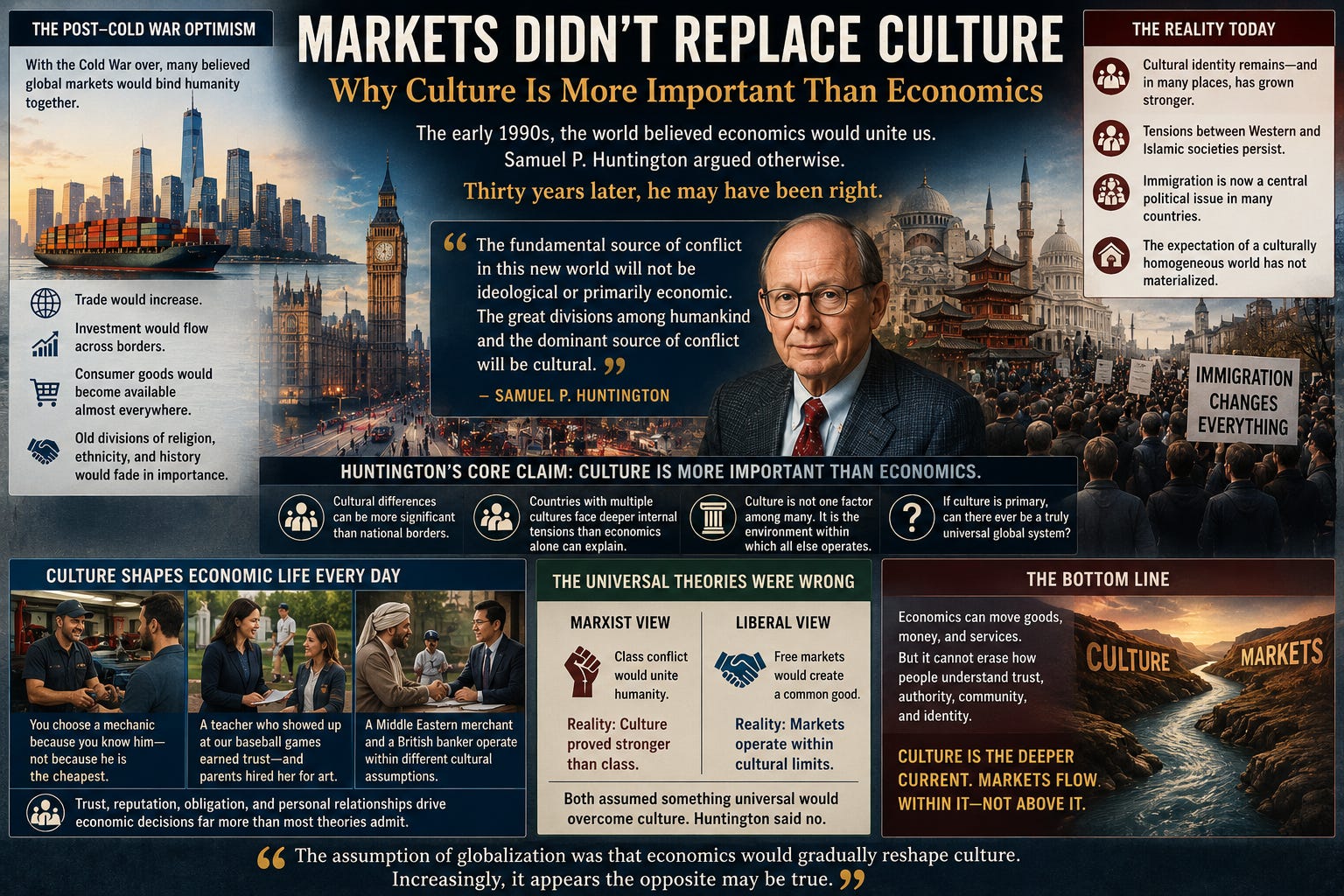
The early 1990s produced an unusual moment in history. With the Cold War over, many believed the globe was entering an era of unprecedented integration. The great ideological struggle between capitalism and communism had ended. What remained was the expectation that economics would become the primary force shaping international affairs.
At the center of this belief was the assumption that global markets would bind humanity together.
Trade would increase. Investment would flow across borders. Consumer goods would become available almost everywhere. As countries became economically interconnected, older divisions of religion, ethnicity, and history were expected to fade in importance.
It was in this atmosphere that Harvard professor Samuel P. Huntington challenged one of the defining assumptions of the age.
His argument was deceptively simple.
Culture was not disappearing.
In fact, Huntington suggested that cultural identity would become more important precisely because the ideological conflicts of the twentieth century had ended. People would continue to define themselves according to language, religion, history, and inherited traditions. These were not superficial characteristics. They formed the basis of how societies understood themselves and how they interacted with others.
The implication was significant.
If culture remained the primary source of identity, then economics could not be the universal solvent many assumed it would become.
Thirty years later, some of Huntington’s observations appear difficult to dismiss. His prediction that tensions would persist between Western and Islamic societies has remained a recurring feature of international politics. More broadly, the expectation that globalization would produce a culturally homogeneous world has not materialized.
Instead, many societies have become more conscious of cultural identity.
Look at how common most political structures now have to deal with the idea immigration has become the dominant fact.
What made Huntington’s argument particularly challenging was that it shifted attention away from national borders alone. Cultural differences, he suggested, could be more significant than political boundaries.
A country containing several distinct cultural groups might therefore face greater internal tensions than economic theory alone would predict.
Economics was not everything.
This perspective was largely absent from the optimism that followed the Cold War. Whether liberal or Marxist, most universal theories shared a common assumption: there existed some mechanism capable of overcoming human differences.
For Marxists, it was class.
For liberals, it was the market.
Both assumed that something universal would ultimately prove stronger than culture.
Huntington disagreed.
He argued that culture was not one factor among many. It was the environment within which all other factors operated.
This raises an uncomfortable question.
If culture remains fundamental, can there ever be a truly universal global system?
Markets can facilitate exchange, but they do not necessarily change how people understand trust, authority, obligation, or community. A merchant negotiating in a Middle Eastern bazaar is operating within a different set of assumptions than a British banker issuing leveraged loans. Neither approach is accidental. Both emerge from long historical traditions.
How many times does somebody go to a garage mechanic because they know them? It isn’t a case of they might be the cheapest. Personal interaction produces a level of trust that is unique.
Growing up one of my teachers regularly came to a lot of our baseball games. That personal interaction led to a number of parents seeing her also as an artist and asking her to do work for them.
Personal interaction contributes a great deal more than most people take to account.
The question is not whether one system is superior to the other.
The question is whether economic integration can ever fully overcome those differences.
If culture remains primary, then a global market may not eliminate divisions. It may simply provide another arena in which those divisions express themselves.
That possibility was largely dismissed during the 1990s and early 2000s.
Today it is considerably harder to ignore.