
Mirror or Messenger? The Changing Role of the Democratic Representative
Democracy’s Dilemma: Between Popular Voice and Elite Judgment

Following.
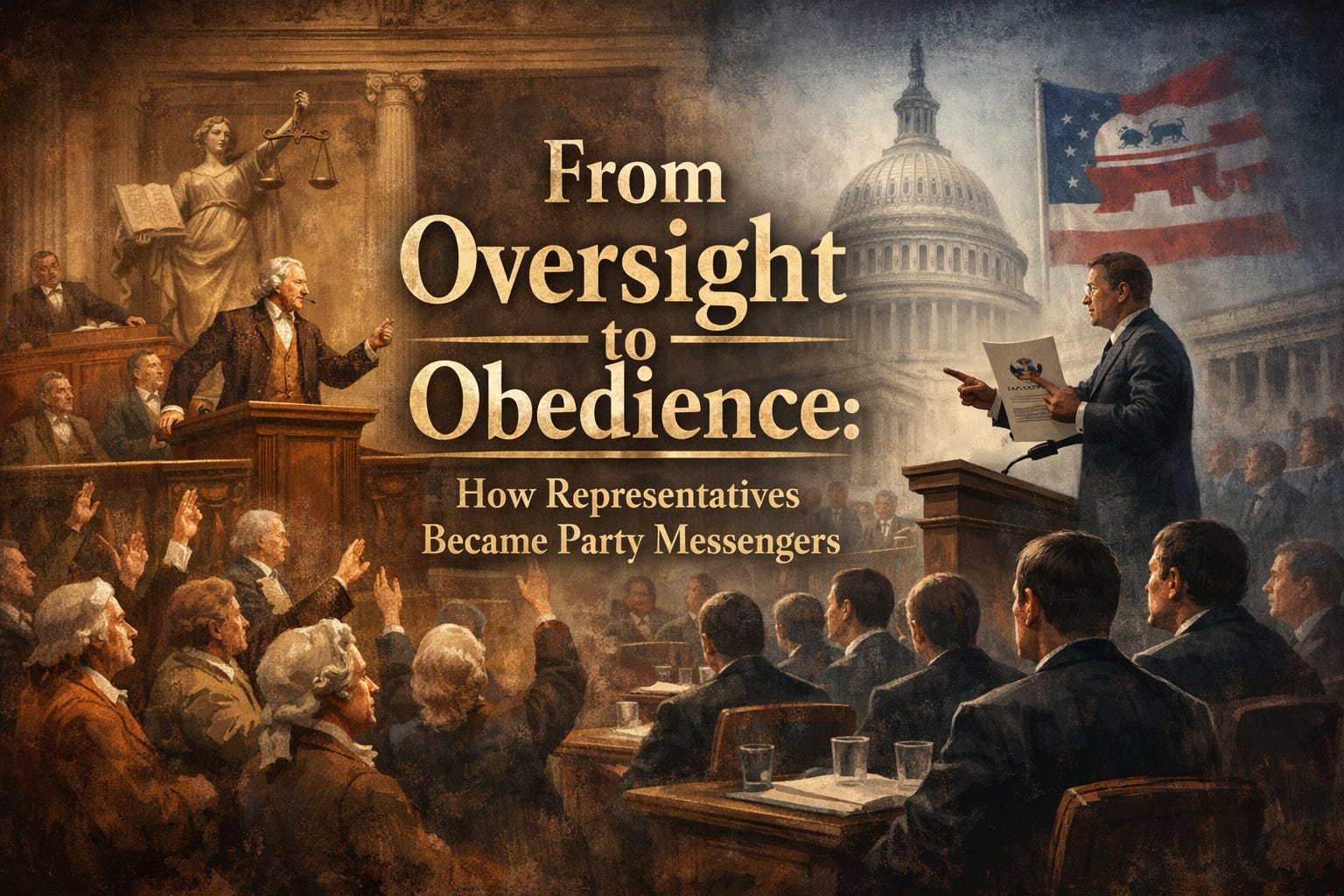
During the late 17th century as early ruminations on democracy started to emerge if you would have suggested that it was a good idea to have the population making too many decisions. Most democratic theory didn’t inherently believe that people ruling was in itself where they wanted to go. Most of the arguments in favor of public input into the government was more that it would provide a defense for the average citizen against being abused by their government.
Electing officials that served in some manner of oversight over what the day-to-day operations of government agencies were doing was the original origin for most modern views on public input.
You still wanted people that were trained in the art of governing and making most of the important decisions. The democratic component then just simply was there to make sure that those solutions didn’t involve anything that might be considered tyrannical. It fell out from what would have been called a mixed constitution. Democratic and aristocratic components working in unison with each other. It also became the general template for most developing constitutional structures.
Britain and the United States are two of the best examples. Both employed parts of both lines of thinking. The House of Commons and Congress being democratic, the House of Lords and the Senate carrying non-democratic political elite selection processes to them. The US Senate was appointed by state governments until the 20th century.
It wasn’t too long however before those that were being elected to the democratic part of the government started wanting more input. This largely was driven by those who were electing them making suggestions on what they thought would fix a problem that they were dealing with. It came to be seen as a reasonable feedback mechanism if somebody living out in the country that rarely was seen by the central government could point to a legitimate practical issue and suggest a solution to it. In short, governments all of a sudden had a method of problem solving that they didn’t have before.
This was especially true with lower levels of government. As municipal councils or state governments were elected much more closely to the population, members of the legislature looking after smaller districts with fewer people probably knew a lot of them, it was much more common to see direct input from a voter to who was representing them.
This positive aspect was obviously not ignored. The argument that those who have to obey laws having an input in making them makes it much more likely that they’re going to respect authority was a driving principle as democracy started to develop. One of the problems autocratic regimes regularly have is the arbitrary nature of the decrees they usually initiate. Most of the general public don’t necessarily understand why they’re being told to do something, not to mention rarely enjoying being ordered around. By contrast direct influence within a democratic system at least suggests there’s some mode of the public being involved in the conversation that produces the final law. It’s much more likely, even if somebody doesn’t necessarily agree with everything in the solution, to at least believe that they were given something of a fair hearing when the decision was being made.
This concept of direct democracy, or at least more direct democracy, did have a bit of a surge through the mid 18th century. It ran into problems because it started to be associated with the revolutionary movement that would eventually overtake France. In short, too much direct democracy can end up turning into a mob. Much like Plato or Aristotle warned about 2,000 years earlier.
One of the concepts that developed was a representative being a mirror of their electorate without actually being beholden to any given passion or opinion in the moment. Representatives would exercise their own judgment. The idea being that a representative was a leader within the community that they were selected from. This was the idea put forward by Edmund Burke when he criticized the French Revolution. It was similar to the idea that those like John Adams or Alexander Hamilton would have suggested in the United States as well.
The elected body was supposed to be representative insofar as it understood the concerns of the public. But they weren’t members of the public in so far as taking referendums all the time. They were representative insofar as they expressed their interests and understood the nature of politics and how to try and get positive outcomes. But they also were more like experts than having a better understanding of how the political process worked than those who had elected them.
At least that was how the theory had expressed things.
This type of trusteeship model is probably the one that is most commonly espoused today in most University seminars. The belief that most politicians are supposed to be an elite of a certain type. They just require constant public approval to be able to do their jobs. This as a concept is part of the legal checks that are put on the . It prevents too many uninformed voters from trying to influence the government directly. There is still the concern of trying to prevent the type of mob mentality that most democratic skeptics have always warned about. On the flip side the trustee is still in theory supposed to be the voice of the community that elects them.
As this is developed it produces a different type of extreme. As opposed to the problem of unelected moms we increasingly now see the problem of most Representatives being beholden to the party center or those who exert direct pressure on the Central party apparatus. In short all too often most Representatives are The Messengers from the central government out to their voters. Carrying what has to be done because those who work in the intellectual center have come up with their own solution.
Mapping through that development will come tomorrow.