
“Why Imposed Futures Create Permanent Enemies"
“You Can Win the Fight and Still Lose the World”

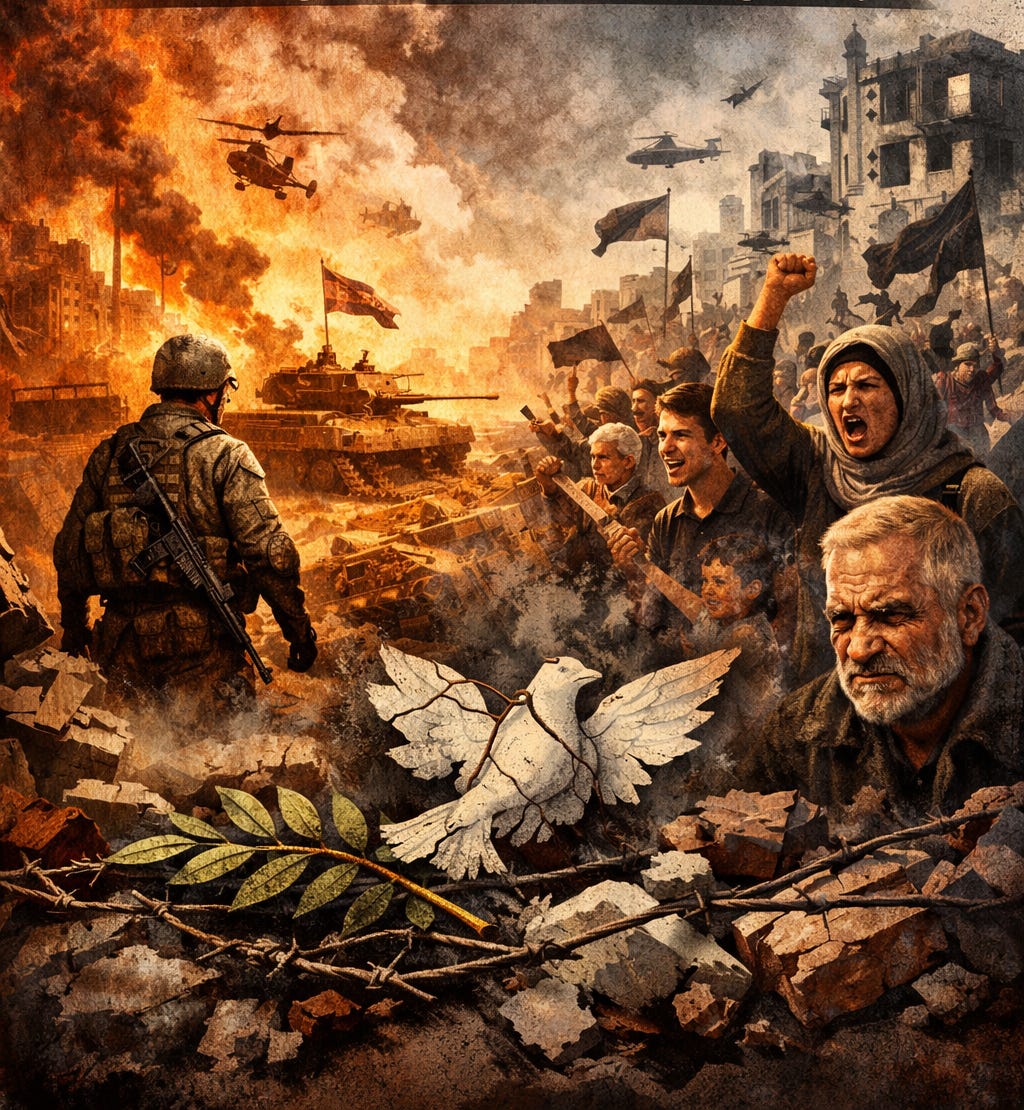
Cicero - an unjust peace is preferable to a just war.
Cicero lived through a period of nearly eternal internal strife. Peace must have been a sweet thought. The Roman Republic in its death throes would go through nearly a hundred years of upheaval.
What makes this position even more perplexing is Rome’s standard disposition towards perpetual war. Since its founding at the end of the 6th century BC, there’s been nearly constant strife and expansion. War was a central part of life; if one was in Rome.
In our current life, we like to believe our culture has become peaceloving. Has it? Promoting war probably is not going to win you too many popularity contests. But for many countries foreign policy is used to not only exert influence, but most believe in imposing specific sets of values on the international system. All too often this ends up entering the conversation whenever conflict does break out.
We increasingly live in a situation, where accepting something you believe to be unjust isn’t simply intolerable. There’s an almost adolescent demand for needing exactly what you wish.
Foreign policy used to be a case of having to deal with things that it was impossible to impose what one wished. The international system being one without an able enforcement mechanism means most actors are able to take their own actions as long as they’re willing to deal with the potential consequences. This is becoming an issue recently as increasingly a number of international organizations like to believe that they’re able to force their own view on how things should be on everyone.
One of the things that’s become much more noticeable with the Russia Ukraine situation is how many foreign analysts refuse to accept any solution that doesn’t punish Russia as they see appropriate. This might be great in theory, the question of how likely it is in practice is a different point.
I’ve made the point before that one of the things with a number of commentators during a conflict is they frequently struggle with looking at the situation as it is at the moment. They like to believe that everything is still at the starting position and they can use that as their template for how things are going to be at the end. In a number of cases the starting point was what caused the war to begin. Not somewhere you want to be. But all too often there’s also been changes in the dynamic that have to be taken into consideration when you’re looking for a conclusion.
Peacemakers that frequently try to find ideal solutions are less than useful. One of the things that defines the international arena is that typically accepting a situation that is less than ideal but tolerable is far more common. It’s a case of trying to put priorities on various ideals. How important is maintaining some sort of peace? Even if it’s uncomfortable or means trading off something else do you value not being in an open conflict?
Can we accept peace if it is not along our own perfect lines? We would prefer to stay in conflict and engage in humility.
If the situation emerged where one could end a conflict, but didn’t necessarily achieve all of their objectives should they pursue it? In the abstract this is a difficult question to answer. But even in practice, it’s become far too often than most would prefer to try and force an issue until they achieve outcomes they’re pursuing. This is even the case where those particular outcomes aren’t necessarily that viable.
It’s almost come to the point where it’s fair to say there are large segments of the international community that favor military action over peace because they’re so set on a particular set of goals. Only if the world unfolds in the fashion in which they expected to are they going to accept not intervening. Building democracies used to be one of these. Increasingly now anything that appears as though the liberal order, which is largely in retreat whether they like it or not, is not still propagating.
One of the things that has never been considered, at least with any depth, is the psychological effect that much of this has.
It isn’t simply the conflict itself. Wars frequently leave a shadow within those who survive intellectually. It is basic human nature that both sides maintain some of their animosity. This is especially so for the loser. Embarking on any sort of physical assault on other humans almost always will end up producing the emotional baggage that ensures that bringing it to a close never makes the hard feelings disappear.
Using conflict as a policy tool guarantees that the other side will hold a grudge against you. Among other things even if you win this typically means a population that’s not going to be easy to deal with after the fighting stops. Among other reasons this is one of those reasons why war was always one of the last options for most foreign offices. It’s become far too easy for many who are trying to recreate a new world to presume that they’re able to mold people anyway they wish. It’s become all too frequent not to pay attention that there might be large segments of the globe that aren’t interested in the same future those at the Atlantic council or within the committees of the United Nations have in mind.
A peace where everybody gets along is not typically followed if there’s been animosity between the two parties. This was one of the points Cicero was making that even if a piece is not necessarily considered just, maintaining some form of cordial relationship can frequently be a better situation than using force to try and impose what one believes to be a more apt situation.
It’s something that fits into the modern era fairly well. If you really are a believer in having a more global system, it makes sense that the countries involved would actually be voluntarily diplomatic with each other. Yet all too often were more than willing to use force to try and push someone into the proper situation. Presuming that a country that has had democracy forced on it, or has been brought into some alignment with an international organization is going to not carry animus towards it is just simply naive.